
A Crisis of Compliance and Infrastructure
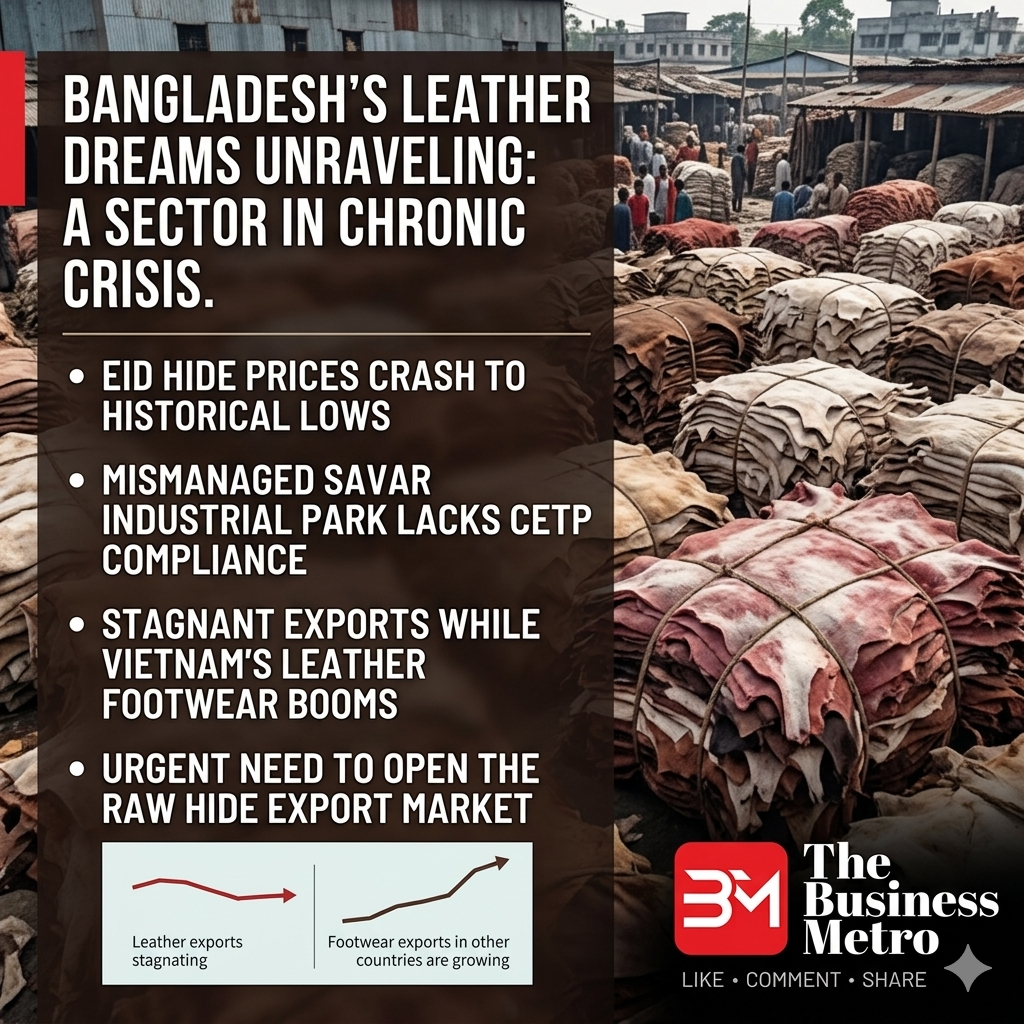
The core issue remains unresolved: the Savar Tannery Industrial Estate’s Central Effluent Treatment Plant (CETP) has failed to operate at full capacity. Consequently, the sector remains unable to meet international environmental compliance standards, effectively locking Bangladesh out of high-value global export markets.
While the Trade and Industry Minister recently suggested that the sector could earn up to $12 billion annually by utilizing its full potential, current data paints a starkly different picture. Bangladesh is currently capturing a mere 0.26% of its potential in the leather industry.
According to Export Promotion Bureau (EPB) data, exports of leather and leather goods stood at $1.13 billion in FY2014-15. A decade later, in FY2024-25, it remains stagnant at $1.14 billion—a glaring contrast to the country’s apparel sector, which saw exports surge from $25 billion to $40 billion in the same period.
The Downward Spiral
The trajectory is not merely stagnant; it is in a state of terminal decline. Export earnings from leather peaked mid-decade before plummeting to $128 million in FY2024-25. The trend persists, with exports reaching just $97 million in the first nine months of the current fiscal year.
Md. Nasir Khan, Vice President of the Footwear, Leather Goods and Accessories Exporters Association, noted that international buyers are systematically rejecting Bangladeshi leather due to environmental and sustainability concerns. "We have effectively squandered a national asset," Khan said. "While Vietnam—which started at a similar position in the 90s—has built the necessary infrastructure and attracted foreign investment to become the world's second-largest footwear exporter, we are operating without a functional waste management system".
Market Distortions and Price Disparity
Despite the government fixing the price for salted cowhides at Tk 62–67 per square foot, market realities have been disconnected from official dictates. In Dhaka, most raw hides were sold for between Tk 300 and Tk 700, far below the calculated value of Tk 1,200 to Tk 1,700 for high-quality hides.
Tannery owners attribute the low prices to the rising costs of imported chemicals, while seasonal traders and warehouse owners (depot owners) point to the high costs of logistics and preservation.
A Path Forward: Market Liberalization
Economist Dr. Khondaker Golam Moazzem, Research Director at the Centre for Policy Dialogue (CPD), argues that the current domestic market lacks the capacity to process the massive influx of leather during Eid. He suggests that the government must allow year-round exports of salted and "wet-blue" leather.
"Opening the market would invite competition, attract new investments, and force an upgrade in quality management," Dr. Moazzem stated. By targeting global importers—such as China, India, and South Korea—who actively purchase raw or semi-processed hides, Bangladesh could finally begin to reverse its fortunes.
Until the fundamental issues of environmental compliance, infrastructure, and market access are addressed, the leather industry risks moving from a potential economic pillar to a neglected relic of the past.