
Shah Amanat International Airport in Chattogram has transformed into one of the prime transit hubs for gold and foreign cigarette smuggling. Despite continuous monitoring by Customs Intelligence and National Security Intelligence (NSI), millions of dollars worth of illegal gold bars and thousands of cartons of premium foreign cigarettes are seized almost weekly.
Contraband is routinely uncovered concealed inside passengers' pants, shoes, laptop bags, or hidden deep within aircraft seat panels and life jackets. This persistent influx raises a critical question: Why does this airport remain the epicenter of smuggling, and what drives this unstoppable supply chain?
Astronomical Duties Drive Massive Profit Margins
The Incentive for Cigarette Smuggling: Every annual national budget increases tariffs on foreign cigarettes. Importing cigarettes outside standard baggage rules currently incurs an staggering customs duty of nearly 800%. Cartons of premium brands like "Mond" or "Dunhill"—purchased in Dubai, Oman, or Sharjah for just BDT 1,000 to 2,000 are sold in the domestic market for BDT 4,000 to 5,000 when smuggled duty-free. This massive profit margin triggers the endless influx at the airport.
The Driver Behind Gold Smuggling: As domestic gold prices skyrocket, dodging local taxes by sourcing gold directly from international hubs like Dubai yields immense profits per bhori (approx. 11.66 grams) when sold to local syndicates.
Free Ticket Trap Exploits Remittance Warriors
The most potent weapon utilized by smuggling syndicates is the demographic of simple, hard-working Bangladeshi migrant laborers stationed across the Middle East.
Kingpins operating out of Dubai or Oman intentionally target low-income laborers preparing to return home. They offer an enticing deal: "Deliver two or three of our suitcases or cartons to Bangladesh, and we will fully fund your airline ticket or pay you a fat commission." Unaware of the severe legal consequences, many expatriates take the bait to save on travel costs, only to be arrested by customs upon arrival.
Unclaimed Baggage Guarantees Risk Free Escapes
A recurring phenomenon at Shah Amanat Airport is the discovery of hundreds of cartons of cigarettes or gold bars abandoned on conveyor belts or inside the customs hall.
This operates on a highly calculated mechanism: syndicate agents place the contraband on the belt and monitor the hall from a distance. If they detect rigorous checking by intelligence operatives, they simply abandon the luggage and walk out of the terminal. Because the lack of immediate ownership eliminates the risk of arrest, smugglers deploy this tactic repeatedly.
Insider Networks Breach High Security Systems
The execution of such highly coordinated smuggling operations within a high-security airport is impossible without the collusion of corrupt ground staff, cleaners, and a section of compromised customs personnel.
Past seizures where gold bars were extracted from aircraft wheel wells or inside sensitive seat back-panels conclusively prove that without internal airline insiders, hiding contraband in such restricted spaces remains impossible.
Revenue Deficits Threaten Domestic Retail Markets
Cigarette smuggling alone bleeds the government of over BDT 4,000 crore in guaranteed annual revenue. Once slipped past airport security, these illegal cigarettes are funneled straight into Chattogram's historic Reazuddin Bazar, from where they are distributed to retail shops nationwide.
To secure the airport, law enforcement must move beyond arresting low-level couriers or naive migrant workers. The primary distributors in Reazuddin Bazar and the international kingpins operating out of Dubai must be brought to justice via Interpol. Concurrently, modernizing airport scanning infrastructure and enforcing absolute accountability among customs officials is paramount.
NEWS
Smuggling Haven: Shah Amanat Airport Unchecked
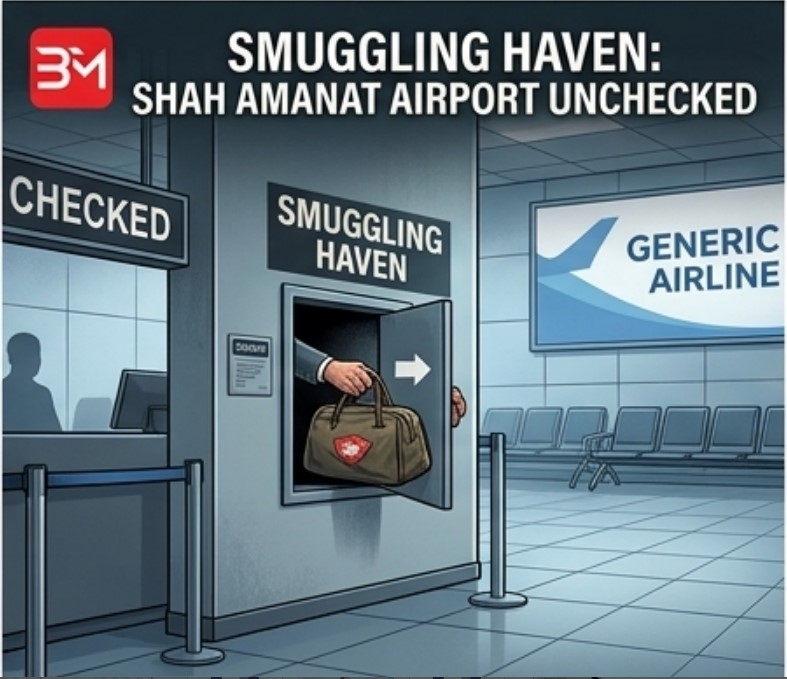
Smuggling Haven: Shah Amanat Airport Unchecked | Photo: BusinessMetro