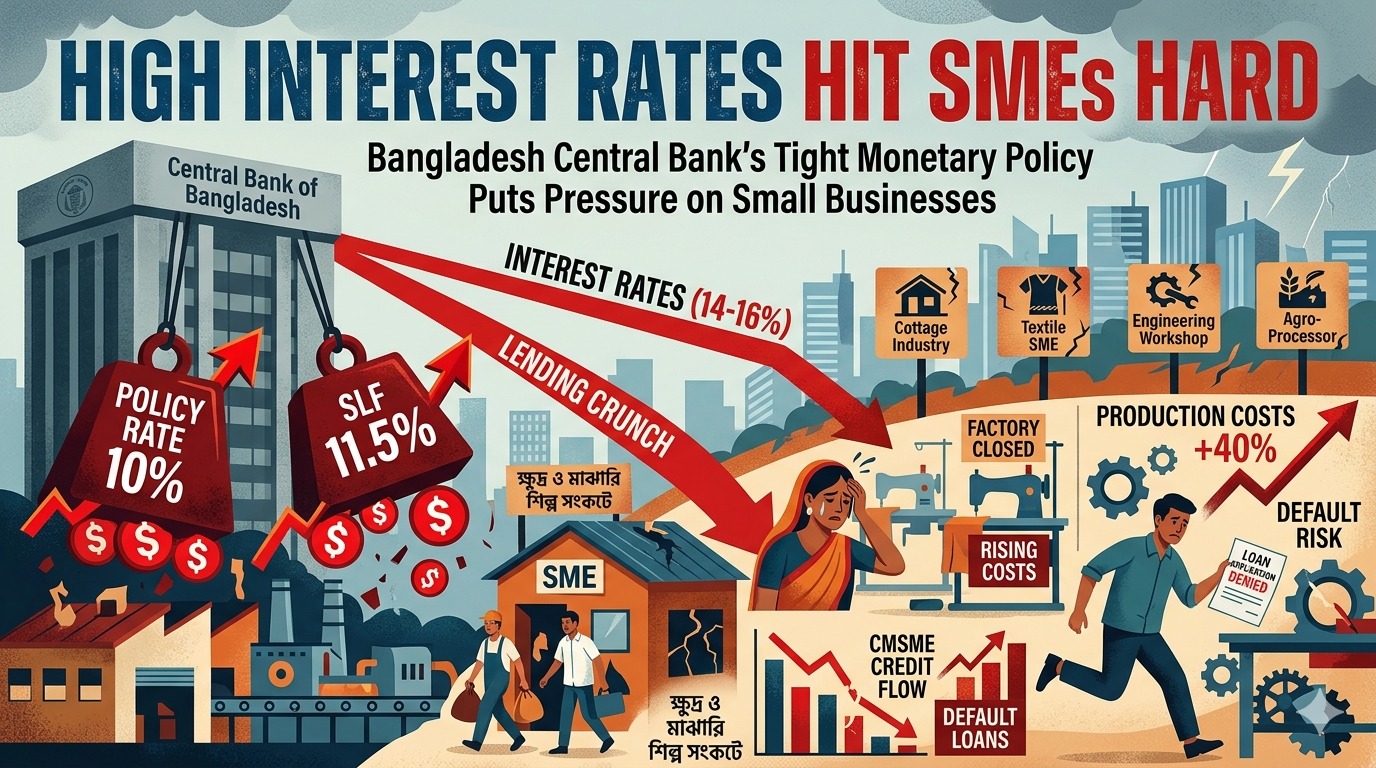
The central bank’s tight contractionary monetary policy and an elevated policy rate of 10% have pushed Bangladesh's Cottage, Micro, Small, and Medium Enterprises (CMSMEs) into a deep crisis. In an attempt to curb rampant inflation, Bangladesh Bank has kept this high policy rate unchanged in its 2026 monetary policy. Consequently, lending rates at commercial banks have skyrocketed. While large corporate houses are somehow managing to absorb the shock, cash-strapped and collateral-deficient small industries are facing gradual extinction.
Skyrocketing Borrowing Costs and Capital Crunch:
To bring inflation down to 7%, the central bank maintains its policy rate at 10% and the Standing Lending Facility (SLF) at 11.5%. As a result, the effective cost of borrowing from commercial banks has surged between 14% and 16% in many cases. Running a business at such exorbitant interest rates has become virtually impossible for small entrepreneurs. Amid rising raw material costs, these high-interest loans are eating into their core capital rather than generating profit.
Bank Reluctance and the "Loan Crunch":
To avoid the risk of Non-Performing Loans (NPLs) in a high-interest market, commercial banks are increasingly preferring large corporate clients over smaller enterprises. Consequently, the credit flow to the CMSME sector has plummeted to its lowest level in four years. Due to a lack of substantial collateral or mortgaged property, banks are rejecting loan applications from cottage and small industries right at the initial stage.
Surging Production Costs and Market Displacement:
Squeezed between soaring electricity and gas tariffs on one side and chora bank interest rates on the other, manufacturing costs for small and medium industries have risen by 30% to 40%. However, due to the declining purchasing power of general consumers, entrepreneurs cannot raise product prices proportionally. Unable to compete with cheaper imported alternatives, many local factories are shutting down operations.
Default Risks and Job Cuts:
Owing to the business slowdown and heavy interest burdens, small entrepreneurs are failing to repay bank installments on time. This has led to an alarming rise in default loans within the CMSME sector. Since the SME sector accounts for nearly 80% of total employment in the country, factory closures and downsizings are forcing thousands out of work, threatening to paralyze the rural economy.
Recognizing the severity of the situation, Bangladesh Bank has relaxed certain rules regarding the Cash Reserve Ratio (CRR) and Statutory Liquidity Ratio (SLR) to facilitate refinance schemes. However, sector experts note that the benefits on the ground remain highly limited, stressing the urgent need for specialized low-interest loans to keep the SME sector alive.